Showing posts with label OCMD. Show all posts

Thursday, October 29, 2015

Perfect City for Your Vacation Home? Try Ocean City MD - We Have It All :)

How to Choose the Perfect City for Your Vacation Home

Image result for vacation home images       Image result for vacation home images
RISMEDIA, Thursday, October 29, 2015— Purchasing a vacation home is a great way to ensure that you always have a place to escape, without worrying about crammed hotel rooms and the inconvenience of living out of a suitcase for a week. When you own a vacation home, you can pack and leave at your convenience, because you always have a home away from home ready for you to utilize. If buying a vacation home appeals to you, you will need to choose the right location to ensure that the home remains a valuable, welcome part of your family. Here are some factors to consider as you make the decision.

Convenience to Your Home

First, determine if the location is convenient enough to make a vacation home appealing. How close is the vacation destination to your home? While it is great to "get away," the reality is that you may not wish to fly every time the opportunity to go on vacation arises. Especially with the rising cost of airline tickets, you may wish to choose a location within a short drive of your home.

Of course, sometimes driving is not an option. If you long for the convenience of a tropical retreat, but you live in the mountains of North Dakota, then go ahead and purchase somewhere tropical. However, before you do, check your local airport to ensure that regular flights are available.

Ongoing Appeal

Your vacation home is an investment that you will use year after year. Before you buy, make sure the area has staying power for your family. You need to buy in an area where your family will want to go annually for vacation. No matter how appealing an area may be the first two or three times you visit, you are investing in years of vacation. Is there really enough for your family to do to be interested long term?

The answer to this question is going to depend largely on your family's vacation style. If you are a lounge-on-the-beach-and-do-nothing type of vacationer, then a cabin on the beach in a remote area is ideal. If you like to see sights and do activities, then you will want to ensure that the city or town nearby has plenty to keep you interested — or even that the vacation home is located near a major amusement park or big city.

Potential Rental Income

Another consideration is what you will do with your vacation home when you are not using it. Do you want to rent out your property to earn some income when you are not using it? While the majority of vacation homeowners do not choose to rent out their property, if you think you may want this option, you will need to buy in a popular destination where vacationing is common. Consider shopping near the mountains, ocean, a lake or a river.

Potential Investment Value

Vacation homes are, at their most basic level, an investment. Evaluate the location to determine if it will be a wise investment with growing value.

In 2014, the number of vacation home sales rose by 57 percent, which is a peak since 2006, according to the National Association of REALTORS®. The vacation-home market accounted for a full 21 percent of the homes sold that year as well. This means there is currently a strong market for vacation properties.

Yet that does not mean a strong market will remain for your vacation property. For that information, you will need to research the area where you are buying with the help of a skilled real estate agent. Choose an area where sales prices are on the way up and where a continuing demand for real estate is projected in the coming years.

Family Interest

Finally, find out what your family thinks. Do they picture themselves vacationing with you, annually, in the same spot? Does the city have enough to appeal to them as well as you? Remember when buying a vacation home you are purchasing your family's memories for years to come. Make sure those memories are tied to a location everyone loves.

With a vacation home, you can build the memories that your family will cherish for a lifetime, and you will also be able to invest in your future financial security. Choose your location wisely, and you will find a vacation home is a welcome addition to your family.

This article was originally published on RISMedia's blog, Housecall. Check the blog daily for more winning real estate tips and trends for you and your clients.

Saturday, October 3, 2015

Buyers: Tips for Negotiating your Home Purchase

7 Negotiating Tips for Homebuyers

Remember these tips during the deal-making process of your home purchase.  

By: Tara-Nicholle Nelson  HGTV
                        
#Ocean City Md - Susan Antigone-ShoreFun4U with Long & Foster -OC  Beach Resort Property
#1: BE QUICK ON THE UPTAKE
It is critical to respond to counteroffers as soon as possible and to avoid making a counteroffer with any term that is not truly a deal breaker. Delays in responding leave space open for another buyer to step in and create a bidding war, or even more likely, for the seller to perceive that other serious buyers might be out there. A seller's mere perception of a hint of a whiff of the scent of a potential bidding war is a homebuyer's number one nemesis, ratcheting up the possible sales price in the seller's head on an exponential basis.
#2: CUT IN THE MIDDLE (WO)MAN
When you want to ask or tell the seller something, always always always go through your real estate agent, who will communicate your request or concern to the seller's agent. I know it seems inefficient, but it is truly a rookie move to contact the seller directly. It's just not done, mostly because the terminology is tough to master and legally sensitive. Also, some seemingly innocent and minor changes to your agreement with the seller might create problems with your lender; your real estate agent is better equipped than you to see these red flags. You hired your agent, so use him/her! It will prevent the catastrophic misunderstandings (read: drama) that can result when you or the seller says something even slightly different than what you each actually mean!
#3: GAUGE THE SITUATION WHEN DEALING WITH A DEVELOPER/BUILDER
A lot of this talk about negotiating and price and terms, etc. may be moot when you're buying a newly built home. By and large, the builder/developer dictates the terms on which they will sell you a home in their community, and you either take it or leave it. The list price is the price you pay, though in many markets, developers and builders are willing to negotiate if they have a large amount of inventory.

The builder will have a standard contract with a standard required deposit, standard contingency removal or objection periods, and a standard set of disclosures that they make to every buyer. The larger the builder, the more set they will be in their ways and to their price. That said, it doesn't hurt to ask for concessions or upgrades. Furthermore, builders hate getting sued, so they generally try to create a standard contract that affords you most or all of the same protections your real estate agent would build into a contract for you.
#4: GET THE DIRT ON PENDINGS
When the sold comps aren't that similar or sold a long time ago, or there is a very similar pending comp, you can go nuts wondering what price the buyer of that pending comp agreed to pay for the place. Sometimes the listing agents of pending comps can be sweet-talked into giving up the dirt. Your real estate agent can call them up, explain the situation, and ask obliquely for contract price hints, like "Did it sell for over (or under) asking? About how far over (or under)? What was the list price to sales price ratio? And how much competition was there? Did you have multiple offers?" And you can also make some educated guesses; the longer it was on the market, the less likely it sold for the asking price. The opposite is true, too. If it went off the market really quickly, it probably sold at or over the asking price.
#5: CHECK THE COMPS
The more money you offer, the more likely the seller will accept. Your real estate agent only gets paid if the seller accepts, so you can see why some agents tend to include or emphasize the highest priced comparables, even if they aren't the most similar comps for your property. Ask your agent for a copy of your Comparative Market Analysis (CMA) and ask for the full MLS listing details of the several most similar comparables. That way, you can decide for yourself how similar they really are!
#6: MAKE YOUR REAL ESTATE AGENT WORK FOR IT
If you are competing with other wanna-be buyers for a property, your real estate agent's prep work and presentation of your offer can be critical to your success. Hopefully you interviewed several real estate professionals and hired one you can trust and know will go the extra mile for you. Always communicate with your agent to ensure you both are on the same page in terms of expectations and deal breakers.
#7: CRUNCH THE NUMBERS
Before you finalize your decision about how much to offer, have your mortgage broker run a monthly payment on your offer price and estimate your property taxes and insurance. Often, buyers inch up in price during the house hunt and in the course of formulating their offer, so it's important to have a final check on the exact monthly and annual obligations you will incur if your offer is accepted.

Also, if you're seriously debating between offering two different prices and are having a hard time making the decision, ask your mortgage professional to run the payment, taxes and insurance on both of the prices you're considering. You might be surprised at how small (or large) an impact a $5,000, $10,000 or $50,000 difference in purchase price has on your ongoing payments, and it may help ease your decision making between the two amounts you are thinking about offering.

Tuesday, September 29, 2015

Buyers & Sellers: Home Values Up or Down? Don't Wait to Buy Your Dream Beach Home

Don’t Wait To Buy Your Dream Home


Posted: 29 Sep 2015 04:00 AM PDT
Don’t Wait to Buy Your Dream Home | Keeping Current Matters

As a seller, you will be most concerned about ‘short term price’ – where home values are headed over the next six months. As either a first-time or repeat buyer, you must not be concerned only about price but also about the ‘long term cost’ of the home.

Let us explain.

There are many factors that influence the ‘cost’ of a home. Two of the major ones are the home’s appreciation over time, and the interest rate at which a buyer can borrow the funds necessary to purchase their home. The rate at which these two factors can change is often referred to as “The Cost of Waiting”.

What will happen over the next 12 months?

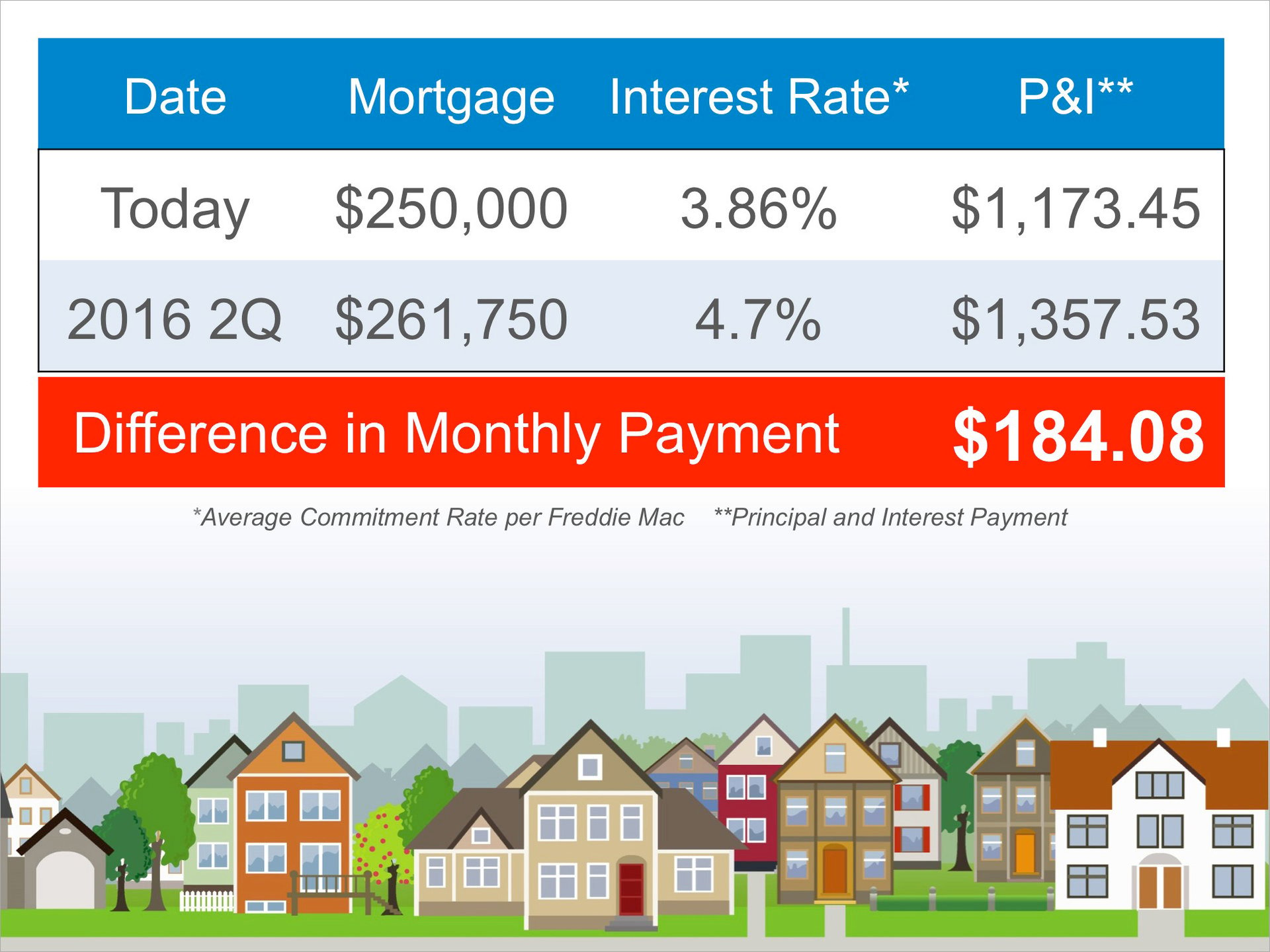
According to CoreLogic’s latest Home Price Index, prices are expected to rise by 4.7% by this time next year. Additionally, Freddie Mac’s most recent Economic Commentary & Projections Table predicts that the 30-year fixed mortgage rate will appreciate to 4.7% in that same time.

What Does This Mean to a Buyer?

Here is a simple demonstration of what impact these projected changes would have on the mortgage payment of a home selling for approximately $250,000 today:Cost of Waiting | Keeping Current Matters

Saturday, September 26, 2015

Why use a Realtor when selling your home?

7 Reasons to Use a REALTOR® When Selling Your Home
                                                   Image result for photo selling your home
RISMEDIA, Saturday, September 26, 2015— Selling your home can seem a daunting task. When you close that deal, you want to make sure that your home goes to the best buyer for the best price. It may seem cheaper to sell your home yourself, and many do; however, there are a lot of details to work through.

“Selling your home through a REALTOR® can help you make sure you get the best value overall,” says Kimberly Nicole, a REALTOR® based in The Woodlands/Houston, Texas metro area who caters to luxury homes and their clientele.

Nicole offers seven reasons why you should use a REALTOR® instead of selling your home yourself:

1. REALTORS® Know How to Navigate the Process – A REALTOR® is the manager of your home buying process. Nicole explains that you and your REALTOR® will begin with extensive discussions to head off any road blocks later on. Your REALTOR® is aware of your concerns, needs and priorities. They are there from the beginning to end, navigating each step of the way with you. Selling real estate can be a tricky business, full of regulations and involved steps. Your REALTOR® works for you, staying on top of the latest regulations and helping you meet them.

2. REALTORS® Know How to Professionally List the Property – In the age of Web 2.0, it’s not enough to upload your phone photos to a few random sites. Buyers expect professional photos, videos and flawless online presentation. To get the most exposure, you also need to manage your listing across multiple channels. REALTORS® will do all this for you, including coordinating with photographers and videographers to make sure your listing is top-notch. “Hitting the right emotional and responsive chords with buyers is the goal,” says Nicole. “Determine who the likely audience is, and market directly to that audience.”

3. REALTORS® Know How to Prepare Sellers – Before you sell, your home must be in the best condition possible. Your REALTOR® can advise you on what repairs need to be done, and they frequently know good contractors. You may have to have inspections done before you sell, and will probably have to do repairs. A REALTOR® can set up any required inspections and instruct you on how to prepare. Sometimes homeowners will take out a loan against the house to finance costly repairs, but this can’t be done while the house is on the market. A REALTOR® may help assess the situation, and then wait to list it until the repairs are completed.

4. REALTORS® Can Help Sellers Prepare for Showings – “Staging is extremely important,” says Nicole. “That first impression is vital.” Not only do all of the repairs need to be done, but if you still live there, the place must be kept clean and staged. This means everything from maintaining curbside appeal to the little details, like placing out a plate of cookies or laying out your best dishes in a table setting. She advises that a home must be open and inviting, and that smells, pets and lighting must all be taken into consideration. “We don’t want a home not selling because a buyer can’t see their own furniture in the home.” Your REALTOR® may also advise you to de-clutter certain closets and rearrange rooms. They may explain which personal touches add a “homey” look and which things detract from a potential buyer envisioning their own decor.

5. REALTORS® Can Help Get Buyers Through the Doors – REALTORS® not only get the traffic in, they know how to manage it. They can arrange and hold open houses in a way that gets as many visitors as possible. They also work with buyers so that showings are more convenient for you. This is especially important if you still live in the house. REALTORS® may also help weed through potential candidates so that you don’t waste your time with no-shows or non-serious buyers. “If a person needs to sell a house before buying another, the seller needs to know this,” says Nicole. This all factors in to final decisions and net proceeds.

6. REALTORS® Know How to Objectively Negotiate – You may think preparing and showing your home may be stressful, but receiving offers can be difficult. “The goal is to get the most money as the seller, and as the buyer the goal is to look at market value and if it’s priced appropriately. You don’t want to present an offer that’s an insult to the seller," says Nicole. A REALTOR® can help you stay reasonable, without letting you take a lowball offer either. They will also be there to navigate a multi-bid and renegotiations. “Renegotiations fall apart all the time, and deals frequently don’t come through,” she says. “Each side has different concerns, and each party needs to know where the other stands.” Closing can be a confusing process, and there is a lot of paperwork to sign. Your REALTOR® has been through this many times and can explain everything you are signing and why. If you have any questions on anything, your REALTOR® is right there.

7. REALTORS® Know the Area – “The key to a good agent is knowing the area,” says Nicole. They know what the property values are, and have a good idea of future market fluctuations. They also know where and how to list your property for best results. Having a home listed on MLS is not enough. A good REALTOR® that is knowledgeable of the area is essential to getting the best deal on your home.

This post was originally published on RISMedia's blog, Housecall. Check the blog daily for real estate tips and trends for you and your clients.

Is Buying a Home a Better Way to Produce Wealth than Renting?

Buying A Home Is Better Way to Produce Wealth Than Renting

According to the latest Beracha, Hardin & Johnson Buy vs. Rent (BH&J) Indexhomeownership is a better way to produce greater wealth, on average, than renting.
The BH&J Index is a quarterly report that attempts to answer the question:
Is it better to rent or buy a home in today’s housing market?
The index examines that entire US housing market and then isolates 23 major markets for comparison. The researchers at use a “’horse race’ comparison between an individual that is buying a home and an individual that rents a similar quality home and reinvests all monies otherwise invested in homeownership.”
Ken Johnson, Real Estate Economist & Professor at Florida Atlantic University, and one of the index’s authors states:
"The U.S. as a whole is still in clear buy territory. The cities of Cincinnati, Chicago, Cleveland, and New York City are deep into buy territory."
Miami and Portland had been inching closer toward renting being the better option but have"pulled back from the edge." Johnson goes on to say, “that's a good sign for home pricing as it suggests prices are going to level off in these metro areas."

Bottom Line

Buying a home makes sense socially and financially. Rents are predicted to increase substantially in the next year, so lock in your housing cost with a mortgage payment now.

Tuesday, August 4, 2015

Selling Your Home? Price It Right From the Start!

Selling Your Home? Price It Right From the Start!


In today’s market, where demand is outpacing supply in many regions of the country, pricing a house is one of the biggest challenges real estate professionals face. Sellers often want to price their home higher than recommended, and many agents go along with the idea to keep their clients happy. However, the best agents realize that telling the homeowner the truth is more important than getting the seller to like them.
There is no “later.”
Sellers sometimes think, “If the home doesn’t sell for this price, I can always lower it later.” However, research proves that homes that experience a listing price reduction sit on the market longer, ultimately selling for less than similar homes.
John Knight, recipient of the University Distinguished Faculty Award from the Eberhardt School of Business at the University of the Pacific, actually did research on the cost (in both time and money) to a seller who priced high at the beginning and then lowered the their price. In his article, Listing Price, Time on Market and Ultimate Selling Price published in Real Estate Economics revealed:
“Homes that underwent a price revision sold for less, and the greater the revision, the lower the selling price. Also, the longer the home remains on the market, the lower its ultimate selling price.”
Additionally, the “I’ll lower the price later” approach can paint a negative image in buyers’ minds. Each time a price reduction occurs, buyers can naturally think, “Something must be wrong with that house.” Then when a buyer does make an offer, they low-ball the price because they see the seller as “highly motivated.” Pricing it right from the start eliminates these challenges.
Don’t build “negotiation room” into the price.
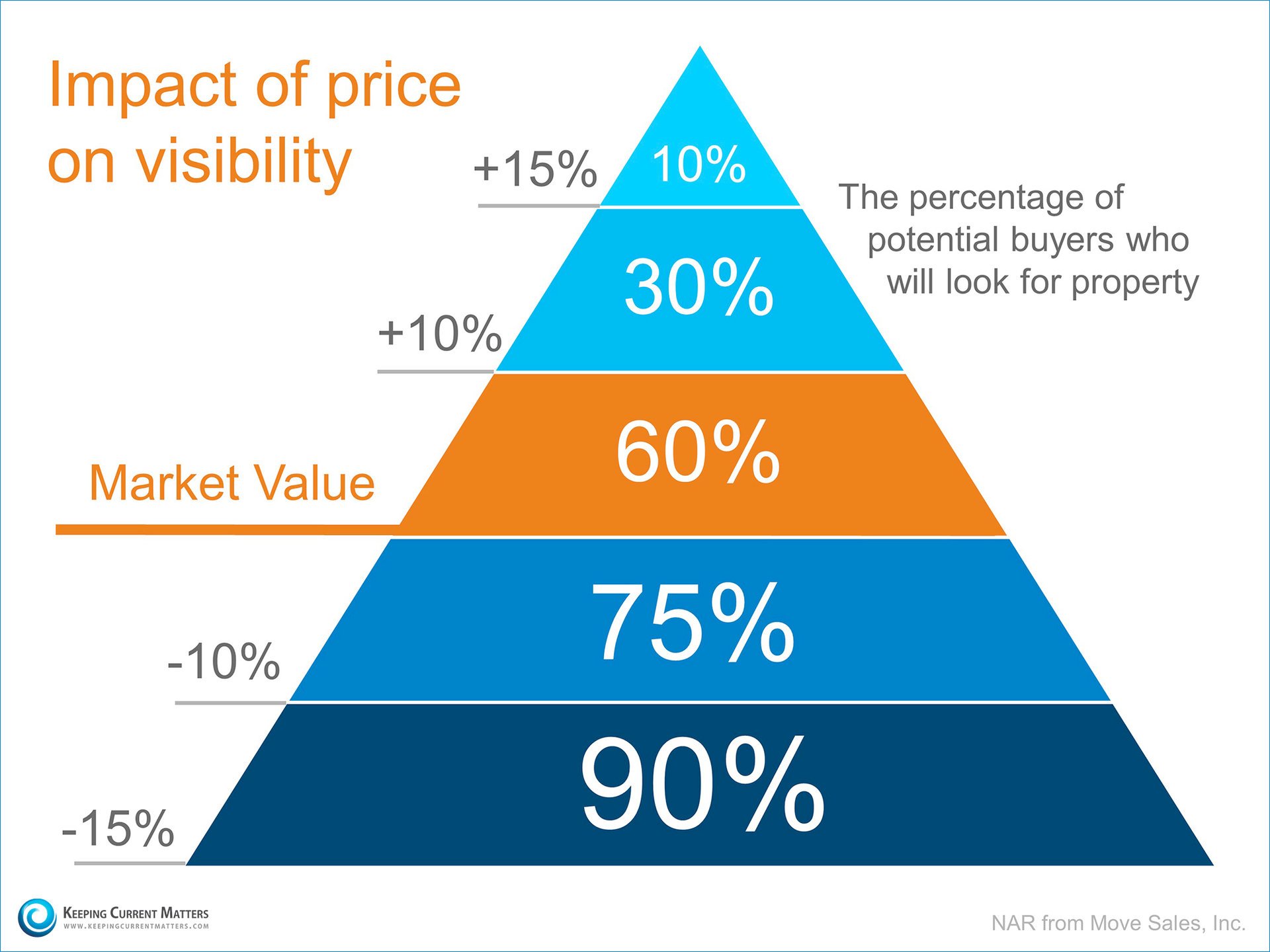
Many sellers say that they want to price their home high in order to have “negotiation room.” But, what this actually does is lower the number of potential buyers that see the house. And we know that limiting demand like this will negatively impact the sales price of the house.
Not sure about this? Think of it this way: when a buyer is looking for a home online (as they are doing more and more often), they put in their desired price range. If your seller is looking to sell their house for $400,000, but lists it at $425,000 to build in “negotiation room,” any potential buyers that search in the $350k-$400k range won’t even know your listing is available, let alone come see it!
One great way to see this is with the chart below. The higher you price your home over its market value, the less potential buyers will actually see your home when searching.
Price & Visibility | Keeping Current Matters
A better strategy would be to price it properly from the beginning and bring in multiple offers. This forces these buyers to compete against each other for the “right” to purchase your house.
Look at it this way: if you only receive one offer, you are set up in an adversarial position against the prospective buyer. If, however, you have multiple offers, you have two or more buyers fighting to please you. Which will result in a better selling situation?
The Price is Right
Great pricing comes down to truly understanding the real estate dynamics in your neighborhood. Look for an agent that will take the time to simply and effectively explain what is happening in the housing market and how it applies to your home.
You need an agent that will tell you what you need to know rather than what you want to hear. This will put you in the best possible position
.

Monday, July 13, 2015

Should I Rent My House Instead of Selling It?

Should I Rent My House Instead of Selling It?  | Keeping Current Matters
The results of Fannie Mae’s June 2015 National Housing Survey, were just released showing that more and more homeowners are warming up to the idea that now may be a great time to sell their home.
The amount of respondents that stated that now is a good time to sell rose three percentage points to a survey high of 52%; which may translate to a healthier market as more homes are listed in the coming months.
At the same time “the percentage of respondents who expect home rental prices to go up rose to 59% – a new survey high.” Doug Duncan, senior vice president and chief economist at Fannie Mae, gave this insight: “The expectation of higher rents is a natural outgrowth of increasing household formation by newly employed individuals putting upward pressure on rental rates.”
There is a chance that those who believe rental prices will rise may consider renting their house rather than selling it at this time.
However, if you have no desire to actually become an educated investor in this sector, you may be headed for more trouble than you were looking for. Are you ready to be a landlord?
Before renting your home, you should answer the following questions to make sure this is the right course of action for you and your family.

10 Questions to ask BEFORE renting your home

  1. How will you respond if your tenant says they can’t afford to pay the rent this month because of more pressing obligations? (This happens most often during holiday season and back-to-school time when families with children have extra expenses).
  2. Because of the economy, many homeowners cannot make their mortgage payment. What percentage of tenants do you think cannot afford to pay their rent?
  3. Have you interviewed experienced eviction attorneys in case a challenge does arise?
  4. Have you talked to your insurance company about a possible increase in premiums as liability is greater in a non-owner occupied home?
  5. Will you allow pets? Cats? Dogs? How big a dog?
  6. How will you actually collect the rent? By mail? In person?
  7. Repairs are part of being a landlord. Who will take tenant calls when necessary repairs come up?
  8. Do you have a list of craftspeople readily available to handle these repairs?
  9. How often will you do a physical inspection of the property?
  10. Will you alert your current neighbors that you are renting the house?

Bottom Line

Renting out residential real estate historically is a great investment. However, it is not without its challenges. Make sure you have decided to rent the house because you want to be an investor, not because you are hoping to get a few extra dollars by postponing a sale.

Sunday, July 5, 2015

Summer Beach Vacation Home: 5 Things to Know Before Renting Out Your Home

men sitting and talking at a table
A credit check can offer insights into your applicant’s payment history and gives you a good idea if they’ll likely be a good or bad credit risk.

Owning a rental property requires hard work, patience, and planning.

Ocean City MD real estate.  Renting or owning a vacation home. 

If you’ve entertained thoughts about renting out your home, you may be asking yourself a few questions: “Is it worth hanging on to this property?” “How will I feel about strangers moving into my home?” “Will my tenants be responsible?”
Owning a rental property can require hard work, patience, and planning. There’s the good to consider, like the potential to increase your income and build a steady cash flow. On the other hand, being a landlord may test your ability to deal with the unexpected, like emergency home repairs or unreliable renters.
Before you hand over the keys, here’s what you can do to make the rental process go smoother.
1. Research the market
Research the market in the neighborhood of your rental home to choose a rent amount that matches local rates while still helping you earn a profit. Consider the square footage and number of bedrooms and bathrooms.
You might also take into consideration any additions to the property and the age of the home. Don’t forget to factor in costs like pest control, lawn maintenance, andoccasional home repairs.
2. Grace your home with curb appeal
The first impression of your home’s curb appeal can mean everything, and depending on where you live and the time of year, your home may have taken a beating from the sun, wind, rain, or snow.
To give your home a fresh look, rent a power washer, clean out the flower beds, and trim shrubs and low-hanging tree branches. Give your lawn a clean trim, your panels a new coat of paint, and your shutters a good cleaning.
3. Check to see if your prospective tenant is financially responsible 
credit check can offer insights into your applicant’s payment history and gives you a good idea if they’ll likely be a good or bad credit risk.
You may also want to consider hiring a reputable company that can perform a tenant screening on your potential occupants to find out if they’ve damaged previous rental properties or have a criminal record. You can also ask for referrals from past residences since this information won’t be included in a credit report.
4. Plan for financial emergencies
Renting comes with its own set of unexpected emergencies, from tenants suddenly vacating a property to their calling you on a Sunday about a broken water heater. These can be tough expenses to bear, and as a landlord, it will behoove you to set aside funds for such situations.
5. Get appropriate insurance coverage
There’s always the possibility that your tenants or one of their guests might have an accident or damage your property. You could also experience a loss of rental income due to an unforeseeable disaster. The proper insurance may cover these things along with legal fees if you end up taking your tenant to court.
For some, becoming a landlord is all about on-the-job training. It can be a challenge, but in the end, renting out your extra space can help you reap financial benefits.
- See more at: http://www.trulia.com/blog/5-things-to-know-before-you-rent-out-your-home/#sthash.kjis2DGg.dpuf