Tax Season: What to Expect When Selling Your Home - http://blog.rismedia.com/2016/tax-season-home-sale/: Tax season is upon us and if you have a pending or recent home sale, you'll surely want to know: what income taxes will you have to pay on the sale?
If you are thinking of Buying or Selling a beach home/condo at the Shore, a Resort Real Estate Specialist is your best bet for accurate information. Licensed in Ocean City MD and the DE Coastal Resort Areas. I will help you through your transaction if you decide that NOW is the right time for you to Buy or Sell. COLDWELL BANKER RESIDENTIAL BROKERAGE. Email: Susan@ShoreFun4U.com Go to: https://OceanCityMD-BeachHomes4sale.com/
Showing posts with label sellers. Show all posts
Sunday, February 28, 2016
Tuesday, February 9, 2016
Real Estate Apps to Help Renters, Buyers, Sellers and Remodelers. Be Knowledgeable and Efficient.
New Real Estate Apps Can Help Renters, Buyers, Sellers and Remodelers
RISMEDIA, Tuesday, February 09, 2016— Real estate technology has grown exponentially since the first Internet boom, and with every passing year the pace seems to accelerate even more.
This summer, I attended multiple real estate conferences around the country and learned about a bunch of new technology that can help renters, home buyers and sellers at every stage of the process. Here’s a round-up of some of the tech that I’ve been keeping an eye on:
For Renters:
RadPad is a popular site for renters in search of their next apartment, condo, house or roommate. It shows how many people have clicked on a listing so potential renters can get an idea of how much interest there is for a specific property.
Another popular feature from RadPad is the ability for renters to pay their rent with a credit or debit card to any landlord in the country. Renters simply pay RadPad directly and the company sends a check to the landlord. This feature is ideal for millennials still renting, because once the check is cashed, they will receive a text confirming that the rent has been paid. It is free if you use a debit card, but there is a small fee for credit card payments.
For Buyers:
Mozaic is a new mobile-optimized social platform that connects buyers and their real estate agents directly to listings in the multi-listing service (MLS) database. It is currently available in Washington and its surrounding markets (i.e. all of the areas served by our MLS for the Mid-Atlantic).
Mozaic’s easy-to-use and collaborative home search enables buyers to share, comment on, select favorites and review homes they are interested in. Buyers can also invite up to 10 friends or family members to join the conversation, share instant feedback and suggest properties.
If buyers are looking for a fixer-upper, for example, and have an experienced carpenter in their social circle, they can invite that person to see their saved listings and share their thoughts about how feasible each project is to take on.
For Mortgage Shoppers:
Fannie Mae jumped into the app development world with HOME, which pulls together mortgage related features usually found on different sites and puts them all in one place.
HOME comes with several calculators — a monthly mortgage estimator, a savings calculator to determine how much to plan for a down payment and an extra-payment calculator to help with the math on reducing the number of years on a mortgage.
There is also a built-in data dictionary and educational resources about home buying. HOME can also connect users directly to HUD-approved housing counseling agencies.
For People Making an Offer on a Home:
After a mortgage, utility expenses are often the next highest cost of living in a home. Now with Enerscore, anyone can find out more about the total monthly cost for a home before they move in, even before they make an offer on the property.
Enerscore uses public records to make up a profile of a home and then determines an energy performance rating. Using this information, the site estimates the monthly utility costs based on local rates for that neighborhood.
For Recent Home Buyers:
The MagicPlan and Floorplanner apps work in conjunction to give users an interactive floor plan of their home.
MagicPlan is a smartphone app that lets you create a floor plan of any room just by walking its perimeter and noting where the corners are. Users can then import the floor plan into Floorplanner and use its library of furniture icons to plan out the furniture arrangement.
For People Renovating a Home:
Kukun (a play on the word ‘cocoon’) gives you the tools to complete renovation projects on time and on budget. After you provide details about a proposed project, Kukun not only gives you an estimate of the cost and a planning tool, but the site also provides a general idea of the financial return on investment for the project once you sell your home.
For Sellers:
roOomy is a virtual staging app that creates a 3D image of any room in your home based on a photo taken with a smartphone or tablet. Users can choose from an extensive furniture catalogue to ‘stage’ the room on their screen.
This is especially helpful to sellers, who can delete images of their existing furniture and virtually replace them with updated pieces so that the listing photos look fresh and inviting. All of the furniture is available for purchase through roOomy’s retail partners directly within in the app.
The proliferation of technology tools to help throughout the entire real estate process isn’t showing any signs of slowing down. By this time next year there will be a whole new crop of options to choose from.
Whether you’re a renter, buyer, seller, renovator or anyone else who works in the real estate industry, there’s a technology tool — or several — to serve your needs.
This article originally appeared in The Washington Post.
This summer, I attended multiple real estate conferences around the country and learned about a bunch of new technology that can help renters, home buyers and sellers at every stage of the process. Here’s a round-up of some of the tech that I’ve been keeping an eye on:
For Renters:
RadPad is a popular site for renters in search of their next apartment, condo, house or roommate. It shows how many people have clicked on a listing so potential renters can get an idea of how much interest there is for a specific property.
Another popular feature from RadPad is the ability for renters to pay their rent with a credit or debit card to any landlord in the country. Renters simply pay RadPad directly and the company sends a check to the landlord. This feature is ideal for millennials still renting, because once the check is cashed, they will receive a text confirming that the rent has been paid. It is free if you use a debit card, but there is a small fee for credit card payments.
For Buyers:
Mozaic is a new mobile-optimized social platform that connects buyers and their real estate agents directly to listings in the multi-listing service (MLS) database. It is currently available in Washington and its surrounding markets (i.e. all of the areas served by our MLS for the Mid-Atlantic).
Mozaic’s easy-to-use and collaborative home search enables buyers to share, comment on, select favorites and review homes they are interested in. Buyers can also invite up to 10 friends or family members to join the conversation, share instant feedback and suggest properties.
If buyers are looking for a fixer-upper, for example, and have an experienced carpenter in their social circle, they can invite that person to see their saved listings and share their thoughts about how feasible each project is to take on.
For Mortgage Shoppers:
Fannie Mae jumped into the app development world with HOME, which pulls together mortgage related features usually found on different sites and puts them all in one place.
HOME comes with several calculators — a monthly mortgage estimator, a savings calculator to determine how much to plan for a down payment and an extra-payment calculator to help with the math on reducing the number of years on a mortgage.
There is also a built-in data dictionary and educational resources about home buying. HOME can also connect users directly to HUD-approved housing counseling agencies.
For People Making an Offer on a Home:
After a mortgage, utility expenses are often the next highest cost of living in a home. Now with Enerscore, anyone can find out more about the total monthly cost for a home before they move in, even before they make an offer on the property.
Enerscore uses public records to make up a profile of a home and then determines an energy performance rating. Using this information, the site estimates the monthly utility costs based on local rates for that neighborhood.
For Recent Home Buyers:
The MagicPlan and Floorplanner apps work in conjunction to give users an interactive floor plan of their home.
MagicPlan is a smartphone app that lets you create a floor plan of any room just by walking its perimeter and noting where the corners are. Users can then import the floor plan into Floorplanner and use its library of furniture icons to plan out the furniture arrangement.
For People Renovating a Home:
Kukun (a play on the word ‘cocoon’) gives you the tools to complete renovation projects on time and on budget. After you provide details about a proposed project, Kukun not only gives you an estimate of the cost and a planning tool, but the site also provides a general idea of the financial return on investment for the project once you sell your home.
For Sellers:
roOomy is a virtual staging app that creates a 3D image of any room in your home based on a photo taken with a smartphone or tablet. Users can choose from an extensive furniture catalogue to ‘stage’ the room on their screen.
This is especially helpful to sellers, who can delete images of their existing furniture and virtually replace them with updated pieces so that the listing photos look fresh and inviting. All of the furniture is available for purchase through roOomy’s retail partners directly within in the app.
The proliferation of technology tools to help throughout the entire real estate process isn’t showing any signs of slowing down. By this time next year there will be a whole new crop of options to choose from.
Whether you’re a renter, buyer, seller, renovator or anyone else who works in the real estate industry, there’s a technology tool — or several — to serve your needs.
This article originally appeared in The Washington Post.
Wednesday, December 2, 2015
Sellers: Preparing for a Home Inspection
How to Prepare Sellers for a Home Inspection
Preparing your sellers for a home for inspection will not only present your property in its best condition, but will also help to prevent closing delays due to incomplete or repeated inspections. Attending to each of the following will ensure a prepared property and a smooth sale.
Below is a partial list of items to help a seller prepare for a home inspection. The full list is available on Tri-State Home Inspections' website.
Seller Preparation
- Make sure all interior and exterior light fixtures work.
- Provide access to the furnace, water heater and electric panel.
- Install a new furnace filter. It will be looked at during the inspection and be considered as part of the overall condition of the furnace or the heat pump.
- Ensure all windows operate smoothly. If some are stuck or painted shut, the impression will be that many windows cannot open.
- Replace all damaged window screens.
- Tighten all doorknobs and tighten or repair all handrails, also check to be sure all interior doors will latch to the strike plate.
- Make sure the attic is accessible, the inspector will enter the attic
- Be sure that there is a minimum of one smoke detector per floor and in every bedroom and that they are in proper working condition
- Provide keys, or unlock sheds and all outside buildings.
- Divert all water away from the house, i.e. down spouts, sump pump, condensation drain, etc.
- Remove grade or mulch from contact with siding, preferably 6 or more inches of clearance.
We can provide your clients with a professional home inspection, pre-drywall inspection, pre-listing inspection, wood destroying organism (termite) inspection, Radon testing, mold inspection and drinking water quality tests.
SOURCE: Tri-State Home Inspections; Eric Espada, ACI,CMI
Monday, November 16, 2015
Sellers: Now or Never??? When will the time be right for you to sell?
Why You Should Sell Now… Before Winter Hits |
|
Posted: KCM Blog 16 Nov 2015 04:00 AM PST
People across the country are beginning to think about what their life will look like next year. It happens every Fall. We ponder whether we should relocate to a different part of the country to find better year-round weather or perhaps move across the state for better job opportunities. Homeowners in this situation must consider whether they should sell their house now or wait. If you are one of these potential sellers, here are five important reasons to do it now versus the dead of winter.
1. Demand is StrongFoot traffic refers to the number of people out actually physically looking at home right now. The latest foot traffic numbers show that buyers are still out in force looking for their dream home. These buyers are ready, willing and able to buy…and are in the market right now! As we get later into the year, many people have other things (weather, holidays, etc.) that distract them from searching for a home. Take advantage of the buyer activity currently in the market.2. There Is Less Competition NowHousing supply is still well under the 6 months’ supply necessary for a normal market. This means that, in many markets, there are not enough homes for sale to satisfy the number of buyers in that market. This is good news for home prices. However, additional inventory is about to come to market. There is a pent-up desire for many homeowners to move as they were unable to sell over the last few years because of a negative equity situation. Homeowners are now seeing a return to positive equity as real estate values have increased over the last two years. Many of these homes will be coming to the market in the near future. Also, new construction of single-family homes is again beginning to increase. A study by Harris Poll revealed that 41% of buyers would prefer to buy a new home while only 21% prefer an existing home (38% had no preference). The choices buyers have will continue to increase over the next few months. Don’t wait until all this other inventory of homes comes to market before you sell.3. The Process Will Be QuickerOne of the biggest challenges of the housing market in recent times has been the length of time it takes from contract to closing. Banks are requiring more and more paperwork before approving a mortgage. Any delay in the process is always prolonged during the winter holiday season. Getting your house sold and closed before those delays begin will lend itself to a smoother transaction.4. There Will Never Be a Better Time to Move-UpIf you are moving up to a larger, more expensive home, consider doing it now. Prices are projected to appreciate by over 18.1% from now to 2019. If you are moving to a higher priced home, it will wind-up costing you more in raw dollars (both in down payment and mortgage payment) if you wait. You can also lock-in your 30-year housing expense with an interest rate below 4% right now. Rates are projected to rise by this time next year.5. It’s Time to Move On with Your LifeLook at the reason you decided to sell in the first place and determine whether it is worth waiting. Is money more important than being with family? Is money more important than your health? Is money more important than having the freedom to go on with your life the way you think you should? Only you know the answers to the questions above. You have the power to take back control of the situation by putting your home on the market. Perhaps, the time has come for you and your family to move on and start living the life you desire.That is what is truly important. |
Friday, October 23, 2015
How to Help get an accurate appraisal on your property
4 Things That Will Dictate The Price Of Your Appraisal
October 23, 2015 By Tom Horn
4 Things That Will Dictate The Price Of Your Appraisal
I often get asked what the price of an appraisal is. This is not a question that is easily answered without getting additional information. While there is a pretty standard fee for properties that are typical for an area there are various things that will dictate the price of your appraisal so we’ll look at these factors today.Location
Location may affect the price of your appraisal if the property is in an area that has sparse sales activity. The typical example of this type of property is one that is located in a rural area. The amount of work and time necessary to complete the assignment increases because it is necessary to do more research to locate comparable sales.
Another reason that the price of an appraisal for this type of property can be higher is that the cost to the appraiser is more. Appraisers must take photos of the sales comparables and this can require driving longer distances to take the photos, which adds to the cost of the appraisal.
Size of the house (Gross Living Area)
The size of the house affects the price because a larger house takes longer to measure and is more time intensive during the property observation. I can look at a smaller house in approximately 30-45 minutes, however it has taken me 3-4 hours to completely inspect a large custom-built home.
In addition to the measurements taking longer walking through the house to note the quality and materials of construction can add to the time spent at the house. Many times these homes have additional improvements as well such as guest quarters and storage buildings to name a few.
Uniqueness of property
The word unique can describe many things, however what we are discussing here is how well your house fits into the neighborhood. If
most properties have 3 or 4 bedrooms with 2 or 3 bathrooms and yours only has 1 bedroom and 1 bath then this would classify it has unique. What if your home looks like a flying saucer? You may laugh, but these homes do exist.
Log homes are another example of a property that you may not consider unique but the sale of them is. From my experience owners of log homes do not usually sell them very frequently so there are not very many comparables available. This makes it necessary to expand typical search parameters and look for sales that are further away or that have occurred further back in time. The research that these types of properties take is typically longer and more in-depth.
Who the appraisal is done for
I know this sounds strange but stay with me here. The amount of work done on an appraisal can sometimes depend on who you are doing it for. For example, most banks that I do work for require the cost approach even though the house may be 40 or 50 years old. The cost approach is really only appropriate for new construction due to the difficulty with estimating depreciation, however completing the cost approach takes additional time and effort which costs more.
In addition to completing sections of the appraisal that may not be relevant there are some forms which banks require that also take time. For these reasons I typically charge more for an appraisal done for a bank or mortgage company, however when doing a pre-listing appraisal these items are not required, and I charge less for them.
The sales comparison approach is the most relevant approach for this type of appraisal because it more closely replicates the process that most buyers will go through in choosing their new home. Buyers typically look at what other similar homes have sold for and also what other homes are currently listed and available for them to buy, so focusing only on this approach is the best method.
Conclusion
The price of an appraisal will vary based on the above criteria. The best way to get an accurate price quote would be to call an appraiser and explain what you want to use the appraisal for and to whom it will be done for. In addition, providing property specific information like what is mentioned above will help the appraiser understand more about the property and allow them to give you a more accurate quote.
Read more http://birminghamappraisalblog.com/appraisal/4-things-that-will-dictate-the-price-of-your-appraisal/
Tuesday, October 20, 2015
Sellers: What Every Seller Should Know About Comparable Sales
What Every Seller Should Know about Comps
RISMEDIA, Saturday, October 17, 2015— “Comps” – or recent comparable sales – give real estate practitioners and appraisers the information they need to price a home at fair-market value. Though comparable data are clear-cut to a professional, how many sellers understand the various tangibles and intangibles that inform these comparisons?
If the gap between seller perception and appraiser opinion is any indication, the answer is few. As a recent Quicken Loans Home Price Perception Index (HPPI) report http://rismedia.com/2015-10-13/homeowners-overvalued-their-homes-for-the-eighth-straight-month-in-september/ shows, homeowner estimates averaged 2 percent higher than those of appraisers – a considerable margin in markets with ballooning home values, says Quicken Loans Chief Economist Bob Walters.
“It may not seem like homeowners assuming their home’s value is 2 percent higher than appraisers’ opinions is significant, but it could make a huge difference in metro areas with higher average home values,” Walters explains.
But this broad brush stroke doesn’t paint a clear picture of every metro area. In Phoenix, for example, which this summer marked the longest streak of year-over-year gains, seller perceptions are more closely aligned with those of professionals.
“In a market that is going up, there isn’t that much of a difference with seller opinions,” says REALTOR® Steffy Hristova of Scottsdale, Ariz. “If the seller has time, the market is moving in the direction they desire. It is harder with sellers who are behind the market – the market moves, but they always think the market will be better tomorrow and it’s too early for them to sell now.”
In those instances of disconnect, the onus is on the agent to educate the seller. Hristova accomplishes this by helping sellers “visualize the data,” presented on one page if possible, and in some cases applying a simple, straightforward formula.
“I adjust the price according to the following schedule: if there are showings and no offers, 4 to 6 percent off; if there are low showings, 6 to 12 percent off; if there are drive-bys only, 12 or more percent off,” says Hristova.
Breaking down the factors that play a role can also be beneficial for the seller. Market activity generally determines the window, but comparable sales can stretch back one month to three months or more. Hristova gleans insight through resources supplied by her regional MLS and
The Cromford Report, provider of residential real estate research and analysis in the Greater Phoenix Area.
“I review statistics from the MLS daily and from available and reliable research sources, study the market dynamics in the neighborhood and in the substitute market for the object property, and review the demand and supply numbers for the zip code and neighborhood and the sales trends,” Hristova explains.
Square footage, a go-to data set for both real estate agents and appraisers, is also on Hristova’s radar. Sellers can expect their home to be evaluated against properties with similar square footage, as well as a like number of bedrooms and bathrooms. Real estate agents may take into account some of the more ambiguous features the appraiser may not consider, as well.
“I focus on the hidden gems of the object property – the ‘wow’ items, the unique design or special appeal of the property,” says Hristova. “It could be the floor plan, specific updates that are particularly attractive, landscaping features, undergrounding wiring, etc. I also analyze potential negatives – types of financing available, location within the neighborhood, proximity to noise, etc.”
And because no two sellers are alike, individual circumstances also warrant consideration. “Will they wait? Will they provide easy access? Will they be willing to repair items?” Hristova asks.
These and other facets, like age, location, lot size, workmanship and energy-efficiency, can all serve as means for comparison. Age, in particular, can be a key variable, because it can indicate the condition (or decrepitude) of the home. According to Trulia, comparables for age are typically pulled within a five-year range.
For sellers, bear in mind comparable data reflect the activities of both buyers and sellers, no matter which the market currently favors. And as Warren Buffett so eloquently sums up:
This post was originally published on RISMedia's blog, Housecall. Check the blog daily for winning real estate tips and trends for you and your clients.hatShou
If the gap between seller perception and appraiser opinion is any indication, the answer is few. As a recent Quicken Loans Home Price Perception Index (HPPI) report http://rismedia.com/2015-10-13/homeowners-overvalued-their-homes-for-the-eighth-straight-month-in-september/ shows, homeowner estimates averaged 2 percent higher than those of appraisers – a considerable margin in markets with ballooning home values, says Quicken Loans Chief Economist Bob Walters.
“It may not seem like homeowners assuming their home’s value is 2 percent higher than appraisers’ opinions is significant, but it could make a huge difference in metro areas with higher average home values,” Walters explains.
But this broad brush stroke doesn’t paint a clear picture of every metro area. In Phoenix, for example, which this summer marked the longest streak of year-over-year gains, seller perceptions are more closely aligned with those of professionals.
“In a market that is going up, there isn’t that much of a difference with seller opinions,” says REALTOR® Steffy Hristova of Scottsdale, Ariz. “If the seller has time, the market is moving in the direction they desire. It is harder with sellers who are behind the market – the market moves, but they always think the market will be better tomorrow and it’s too early for them to sell now.”
In those instances of disconnect, the onus is on the agent to educate the seller. Hristova accomplishes this by helping sellers “visualize the data,” presented on one page if possible, and in some cases applying a simple, straightforward formula.
“I adjust the price according to the following schedule: if there are showings and no offers, 4 to 6 percent off; if there are low showings, 6 to 12 percent off; if there are drive-bys only, 12 or more percent off,” says Hristova.
Breaking down the factors that play a role can also be beneficial for the seller. Market activity generally determines the window, but comparable sales can stretch back one month to three months or more. Hristova gleans insight through resources supplied by her regional MLS and
The Cromford Report, provider of residential real estate research and analysis in the Greater Phoenix Area.
“I review statistics from the MLS daily and from available and reliable research sources, study the market dynamics in the neighborhood and in the substitute market for the object property, and review the demand and supply numbers for the zip code and neighborhood and the sales trends,” Hristova explains.
Square footage, a go-to data set for both real estate agents and appraisers, is also on Hristova’s radar. Sellers can expect their home to be evaluated against properties with similar square footage, as well as a like number of bedrooms and bathrooms. Real estate agents may take into account some of the more ambiguous features the appraiser may not consider, as well.
“I focus on the hidden gems of the object property – the ‘wow’ items, the unique design or special appeal of the property,” says Hristova. “It could be the floor plan, specific updates that are particularly attractive, landscaping features, undergrounding wiring, etc. I also analyze potential negatives – types of financing available, location within the neighborhood, proximity to noise, etc.”
And because no two sellers are alike, individual circumstances also warrant consideration. “Will they wait? Will they provide easy access? Will they be willing to repair items?” Hristova asks.
These and other facets, like age, location, lot size, workmanship and energy-efficiency, can all serve as means for comparison. Age, in particular, can be a key variable, because it can indicate the condition (or decrepitude) of the home. According to Trulia, comparables for age are typically pulled within a five-year range.
For sellers, bear in mind comparable data reflect the activities of both buyers and sellers, no matter which the market currently favors. And as Warren Buffett so eloquently sums up:
This post was originally published on RISMedia's blog, Housecall. Check the blog daily for winning real estate tips and trends for you and your clients.hatShou
Tuesday, September 29, 2015
Buyers & Sellers: Home Values Up or Down? Don't Wait to Buy Your Dream Beach Home
Don’t Wait To Buy Your Dream Home |
|
Posted: 29 Sep 2015 04:00 AM PDT

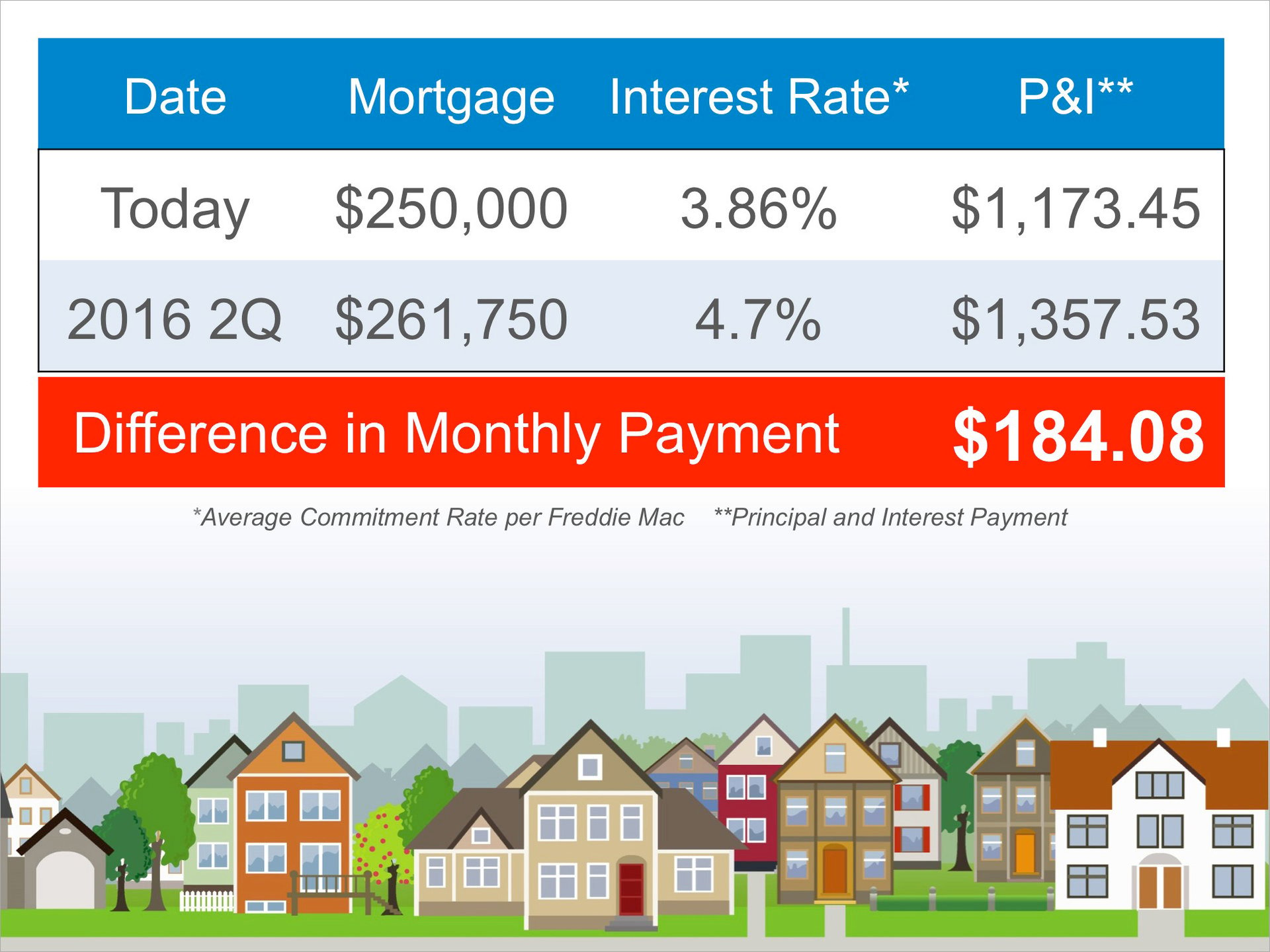
As a seller, you will be most concerned about ‘short term price’ – where home values are headed over the next six months. As either a first-time or repeat buyer, you must not be concerned only about price but also about the ‘long term cost’ of the home.
Let us explain.There are many factors that influence the ‘cost’ of a home. Two of the major ones are the home’s appreciation over time, and the interest rate at which a buyer can borrow the funds necessary to purchase their home. The rate at which these two factors can change is often referred to as “The Cost of Waiting”.What will happen over the next 12 months?According to CoreLogic’s latest Home Price Index, prices are expected to rise by 4.7% by this time next year. Additionally, Freddie Mac’s most recent Economic Commentary & Projections Table predicts that the 30-year fixed mortgage rate will appreciate to 4.7% in that same time.What Does This Mean to a Buyer?Here is a simple demonstration of what impact these projected changes would have on the mortgage payment of a home selling for approximately $250,000 today: |
Wednesday, September 16, 2015
Is Your Agent Asking 3 Critical Questions
In order to help focus a buyer on what is important to them in the home buying process, and help them decide if "NOW" is the right time to 'jump' if they see the home of their dreams, a real estate agent might want to ask the following questions. These questions can help pin point potential issues that are better resolved early in the Agent/Client relationship and result in a more satisfying and successful real estate transaction sooner rather than later.

To begin with, has your Agent started with this question: "At what price would you see value in this property and be comfortable making an offer?" Rather than wait for a buyer to approach the Agent and suggest an offer, listing agents should remove the price barrier to further negotiations, increase the chances of multiple offers, and better gauge the home's market value.
Secondly, has your Agent also asked you, the buyer, to discuss on a tour the home's positive and negative aspects to determine whether there are any minor cosmetic issues that could easily be remedied to eliminate any perceived negative impact on value.
Finally, has your Agent asked you, "If you come across your dream home today, are you in a position to take the first steps and secure it?" This inquiry helps the agent gauge whether you, the prospect, have been pre-approved for a loan, whether you have a home that the agent's firm could potentially sell, and whether the agent should refer you to the firm's mortgage broker.
Knowing if an agent is the right one for any buyer or seller is a subjective evaluation. However, certain standards of practice are always followed by agents who are top in their field and understand what steps to take in what order to ensure a successful and stress free transaction.
[Adapted from: "3 Critical Questions You Must Ask Every Potential Buyer"
REBusinessOnline.com (08/06/15) ; Dounis, Billy]
Do you know the difference between a Fixture and Personal Property in a Home Sale?
What’s a Fixture vs Personal Property
What Stays and Goes in a Home Sale
Any good Realtor should be well aware of the problems that can arise over the definition of fixtures in a home, and should prepare appropriately in the sales process. By getting clear from the start on what fixtures are versus personal property, the Realtor can help everyone enjoy a smoother transaction.
Many consumers have no idea what is considered a fixture and what is considered personal property. In fact many real estate agents are to blame for blurring the lines between these two things by “excluding” things in a listing agreement that don’t need to be excluded!
For example unless a washer and dryer is “built in” it does not need to be excluded as it is considered “personal property” and not part of the home. Refrigerators are also considered personal property unless they are built-in to the cabinetry like a “Sub-Zero”. This creates confusion on the part of the consumer when fixtures and personal property are treated in the same fashion.
Keep reading and you will see a comprehensive discussion on what is considered personal property and what is considered “real estate” or part of the property when selling a home.
What’s A Fixture?
A fixture is legally considered something like decorations, equipment or appliances that have been attached to the house. Fixtures are considered part of the property and it is a given that they will go to the buyer along with the rest of the property.
For instance, if you were to buy a house from a seller and discovered that he had removed all the door knobs when he moved out, you’d understandably be angry. The doorknobs are part of the house, and are definitely something you expected to get when you spent hundreds of thousands of dollars on it. Fortunately, sellers rarely run off with doorknobs. They are obviously fixtures, and obviously are included in the sale. But there are other things that you as a buyer may consider fixtures that the seller does not.
There are a few ways to look at fixtures in a home to determine their status, including:
Attachments
When something is screwed, nailed or glued to the walls, ceiling or floors, it can generally be considered an attachment. Even if you can technically remove the item, it may still be considered an attachment – things like custom cabinets, built-in speakers, etc.
Integral
The item may also be something that is generally considered an integral part of a home, like a refrigerator (if built in), cooking range, or a porch swing.
Guidance from the Greater Boston Real Estate Board
The Greater Boston Real Estate Board standard purchase and sale agreement has language that discusses what is and is not a fixture. The language is very helpful because it outlines in detail for both the buyer and seller what is and is not part of the property. There is a clear definition of what conveys and what does not.
“Included in the sale as part of said premises are the buildings, structures, and improvements now thereon, and the fixtures belonging to the SELLER and used in connection therewith, including, if any, all wall-to-wall carpeting, drapery rods, automatic garage doors openers, Venetian blinds, window shades, screens, screen doors, storm windows and doors, awnings, shutters, furnaces, heaters, heating equipment, stoves, ranges, oil and gas burners and fixtures appurtenant thereto, hot water heaters, plumbing and bathroom fixtures, garbage disposals, electric and other lighting fixtures, mantels, outside television antennas, fences, gates, trees, shrubs, plants, and ONLY IF BUILT IN, refrigerators, air conditioning equipment, ventilators, dishwashers, washing machines and dryer; and but excluding _______.”
How Personal Property And Fixtures Can Become Confused
It is not hard to imagine how the line between fixture and personal property could become muddled. If a home had an alcove above the stove that contained a high-end microwave, the buyer may imagine that the appliance comes with the house, especially if the microwave looked to be a part of the style of all the appliances in the kitchen. But the seller might have just bought the microwave to replace an old one. It’s not physically attached to the house, just sitting in its alcove. All he has to do is unplug it and take it when he leaves.
A few years ago while selling a home in Southborough Mass, a seller decided to take the control box for an underground dog fence. Needless to say it was not excluded and the buyer was very unhappy about it. These are the kind of things that can add quite a bit of stress to a real estate transaction.
Items That Cause The Most Issues
- Window treatments – this is one of my biggest pet peeves because it seems so many real estate agents do not grasp the concept. Curtains and drapes are considered personal property and do not stay with a home. Rods and blinds, however are attached and therefore stay with the home.
- A swing set – This can go either way because some swing sets are just sitting in the grass. This would be considered personal property as it is not attached to anything. A swing set however that is cemented into the ground would be considered a fixture or part of the property.
- A basketball hoop – the same can be said for a basketball hope. It goes without saying that if the hoop is cemented into the driveway it will stay with the home unless excluded from the sale. A free standing hoop however, would be considered personal property.
- A mirror – this should be simple but often times it is not. If the mirror is bolted to the wall it stays. If it is hanging on a hook it does not stay with the home.
- A wall mounted television – this is another one that really can be grey to a lot of people. Wall mounted televisions should be excluded if an owner desires to take them. Keep in mind anything bolted, screwed in or attached to a wall is considered part of the house! A sub issue that often times surfaces with wall mounted televisions is how the holes in the wall that are left behind will be addressed. Do not assume anything here when buying a home. If you want the holes patched this is something that should be addressed up front and agreed to in writing by the parties.
- Lights – this one is one my list not because it is hard to distinguish that they are part of a home but because a lot of home owners forget to exclude lights they want to take with them. Some sneaky owners will take a light and put another in it’s place thinking the buyer will not remember. This is not a good way to conduct yourself in a real estate transaction but it happens.
- Dog fence – this is an interesting one only because some sellers think it is perfectly acceptable to take the unit that powers the underground wiring. This is something that should become an exclusion.
Clarifying What Is What
When a Realtor goes to list a home, he or she should be extremely thorough in defining what is included in the home sale. When the listing is put up, it should contain all the fixtures that are excluded from the sale. I will repeat again when excluding items from a sale, personal property should not be included as it creates further confusion.
The same attention to detail must be applied when the Offer to Purchase is drafted. When the multiple listing service is thorough and exact in its descriptions of what comes with the house, it can then be referred to later in the Offer to Purchase. The same information on what is included in the sale and what is excluded in the sale must be made clear in the offer.
Make Sure You And Your Realtor Are On The Same Page
47If you are going to sell your house, you want to make sure that you and your Realtor are always on the same page. A good real estate agent should be checking in with you, especially at the beginning of the sale, to make sure you understand what is going on and that your wishes are being honored in the sales process.
What is included and excluded should be discussed before the home is ever listed and it makes its way to the public.
When you talk to your Realtor about the listing, bring up the idea of clarifying what you consider personal property and what you consider fixtures, so that the Realtor can include all this information in the listing. After the listing is up, the real estate agent can also keep in mind any areas where confusion might arise and address them during the sales process with the buyers agent.
The last thing you want to be involved in is a situation where the buyer wants to back out of the home sale. This is stress that can be easily avoided!
Other Important Clarifications
One of the other bones of contention that often comes up in a home sale are extraneous things that the seller decides they should leave behind for the buyer to have. Sometimes the buyer loves the fact that these things are left behind and other times they want them gone. What kind of items am I talking about?
- Paint – some buyers want all the paint left behind to do touch ups while others have no use for it and want it removed.
- Extra tile – again sometimes people want extra tiles to stay and other times they plan on removing what is there.
- Gardening items, pesticides, etc – some buyers love to have these things, while others don’t.
- Wood – Some sellers see leaving wood for burning in the fireplace or wood stove as a major plus.
- Miscellaneous items – anything that can be used around the house like garden houses, garbage cans, household cleaners, etc.
The point here is you should never take anything for granted when it comes to leaving items behind. A buyer should always be asked if they want anything left behind that is considered personal property.
Do a Final Walk Through
When you are buying a home it is always advisable to do a final walk through. One of the major purposes of doing so is to make sure that everything in the home is the same as when you signed your contact with the seller. While most buyers are looking for issues like a mover dinging a wall or other potential structural or mechanical issues, looking over what was supposed to be included is important as well.
Over my twenty eight years of selling real estate there have been a handful of occasions where something was taken that shouldn’t have been. In fact one time the seller had already left the state with all of their belongings on a truck and decided they wanted two lights that were not excluded.
The buyer of course wanted them and would not settle for what the seller put in their place. It took some wrangling of course with the attorneys but a holdback agreement was made where by the seller would not get a couple thousand dollars of their proceeds until the lights were returned to the buyers. This is just another reason that a final walk through should never be skipped!
Subscribe to:
Posts (Atom)


