Showing posts with label buyers. Show all posts

Friday, February 19, 2016

Are you about to be an Empty Nester? Kids Moving Out? It's about their First Home!

Are the Kids Finally Moving Out?


During the recession, many young adults graduating from college were forced to move back in with their parents. This caused new household formations to drop dramatically from the long term average of 1.2 million formations annually to half that number. However, this may be the year this turns back around.

According to the Urban Land Institute’s report, Emerging Trends in Real Estate, household formations will increase dramatically. They project that 3.68 million additional households will be formed in the next three years. This brings household formations back to pre-recession numbers of 1.2 million a year

What will happen in 2016?


One of the key indicators to an improving housing market is household formation: How many people are moving out and forming an independent living unit? Many of the people “moving out on their own” will be those Millennials who can finally move from their parents’ basements to their first home.
Not every person moving out will decide on an apartment. A certain percentage of consumers will decide that homeownership is a better option for themselves and their families.
Jonathan Smoke, Chief Economist at realtor.com, believes:
“Demand for for-sale housing will grow and will continue to be dominated by older millennials, aged 25 to 34. This demographic has the potential to claim a third of home sales in 2016 and represent 2 million home purchases.”

What about household formations moving forward?

And Louis Keely, the President of The Demand Institute, predicts strong household growth will continue over the next ten years:
“We expect new household formation to be robust over the next decade as the large millennial generation ages and forms new households of their own.”

Bottom Line

Here come the Millennials!! They will finally be entering the housing market in 2016 and will dominate real estate sales over the next decade.

Tuesday, February 9, 2016

Real Estate Apps to Help Renters, Buyers, Sellers and Remodelers. Be Knowledgeable and Efficient.

                        New Real Estate Apps Can Help Renters, Buyers, Sellers and Remodelers


RISMEDIA, Tuesday, February 09, 2016— Real estate technology has grown exponentially since the first Internet boom, and with every passing year the pace seems to accelerate even more.

This summer, I attended multiple real estate conferences around the country and learned about a bunch of new technology that can help renters, home buyers and sellers at every stage of the process. Here’s a round-up of some of the tech that I’ve been keeping an eye on:

For Renters:
RadPad is a popular site for renters in search of their next apartment, condo, house or roommate. It shows how many people have clicked on a listing so potential renters can get an idea of how much interest there is for a specific property.

Another popular feature from RadPad is the ability for renters to pay their rent with a credit or debit card to any landlord in the country. Renters simply pay RadPad directly and the company sends a check to the landlord. This feature is ideal for millennials still renting, because once the check is cashed, they will receive a text confirming that the rent has been paid. It is free if you use a debit card, but there is a small fee for credit card payments.

For Buyers:
Mozaic is a new mobile-optimized social platform that connects buyers and their real estate agents directly to listings in the multi-listing service (MLS) database. It is currently available in Washington and its surrounding markets (i.e. all of the areas served by our MLS for the Mid-Atlantic).

Mozaic’s easy-to-use and collaborative home search enables buyers to share, comment on, select favorites and review homes they are interested in. Buyers can also invite up to 10 friends or family members to join the conversation, share instant feedback and suggest properties.

If buyers are looking for a fixer-upper, for example, and have an experienced carpenter in their social circle, they can invite that person to see their saved listings and share their thoughts about how feasible each project is to take on.

For Mortgage Shoppers: 
Fannie Mae jumped into the app development world with HOME, which pulls together mortgage related features usually found on different sites and puts them all in one place.

HOME comes with several calculators — a monthly mortgage estimator, a savings calculator to determine how much to plan for a down payment and an extra-payment calculator to help with the math on reducing the number of years on a mortgage.

There is also a built-in data dictionary and educational resources about home buying. HOME can also connect users directly to HUD-approved housing counseling agencies.

For People Making an Offer on a Home:
After a mortgage, utility expenses are often the next highest cost of living in a home. Now with Enerscore, anyone can find out more about the total monthly cost for a home before they move in, even before they make an offer on the property.

Enerscore uses public records to make up a profile of a home and then determines an energy performance rating. Using this information, the site estimates the monthly utility costs based on local rates for that neighborhood.

For Recent Home Buyers: 
The MagicPlan and Floorplanner apps work in conjunction to give users an interactive floor plan of their home.

MagicPlan is a smartphone app that lets you create a floor plan of any room just by walking its perimeter and noting where the corners are. Users can then import the floor plan into Floorplanner and use its library of furniture icons to plan out the furniture arrangement.

For People Renovating a Home:
Kukun (a play on the word ‘cocoon’) gives you the tools to complete renovation projects on time and on budget. After you provide details about a proposed project, Kukun not only gives you an estimate of the cost and a planning tool, but the site also provides a general idea of the financial return on investment for the project once you sell your home.

For Sellers: 
roOomy is a virtual staging app that creates a 3D image of any room in your home based on a photo taken with a smartphone or tablet. Users can choose from an extensive furniture catalogue to ‘stage’ the room on their screen.

This is especially helpful to sellers, who can delete images of their existing furniture and virtually replace them with updated pieces so that the listing photos look fresh and inviting. All of the furniture is available for purchase through roOomy’s retail partners directly within in the app.

The proliferation of technology tools to help throughout the entire real estate process isn’t showing any signs of slowing down. By this time next year there will be a whole new crop of options to choose from.

Whether you’re a renter, buyer, seller, renovator or anyone else who works in the real estate industry, there’s a technology tool — or several — to serve your needs.

This article originally appeared in The Washington Post.

Tuesday, January 26, 2016

Buying? What You Will Need to Finance a Vacation Home


What You’ll Need to Finance a Vacation Home 
By   Beth Braverman  for  Realtor.com  January 19, 2016


 Growing numbers of Americans these days are living a prime variation of the real estate dream: you know, the one about owning a property in your favorite place that you can use as a second home or just a much-needed escape from the pressures or banality of the everyday. In fact, the phrase “vacation home” practically makes us giddy, whether the place in question is located in the mountains, on the water, or in a bustling city.

Interested? Obsessed, even? Then you’d better get your finances into tiptop shape.

Certainly you’ll find plenty of company. Vacation home sales soared to 1.13 million in 2014, according to the National Association of Realtors®. That’s the highest level since NAR began the survey in 2003, and a 57% increase from 2013.

The spike reflects an improving economy—as well as demographic shifts that have more baby boomers purchasing vacation homes intended to serve as their primary residence after retirement. (Want to win a fabulous vacation home? Click this link to enter the HGTV Dream Home sweepstakes, and you’ll get a bonus entry!)

Seven in 10 vacation-home buyers use a mortgage to finance the purchase. So if you’re considering buying a second home, here’s what your lender will be looking for:

Good credit
                              
You’ll need a credit score in at least the mid-600s to qualify for a mortgage on a vacation home, but the higher your score the better rate you’ll get on the loan.

“Our best rates tend to be for clients who have a 720–740 FICO score,” says Quicken Loans Vice President Bill Banfield. “As the score goes down, the costs increase incrementally.”

If you know you’ll be making a vacation home purchase in the near future, check your credit reports now to see if there are any errors or if your score needs improvement.

A higher down payment
While there are conventional loan programs for primary home residences that allow you to make a purchase with as little as 5% down, you’ll need to put down at least 10% for a vacation home. As with conventional mortgages, putting down at least 20% will give you access to the best possible rates without having to pay mortgage insurance.

Extra cash on hand
In addition to having enough assets to cover closing costs and moving expenses, you’ll need to have cash reserves equal to at least two months’ worth of expenses on the vacation property in order to get loan approval.

Income to support both properties
Ideally, lenders are looking for a debt-to-income ratio of 43% or less for both the vacation home and your primary residence. Typically, that means the total cost of the mortgages and taxes on both homes, along with any other household debt such as student loans or car payments, can’t equal more than 43% of your total family income. In some circumstances, lenders may be able to make an exception.

“If you’re pushing the envelope with your debt-to-income, it helps to have a higher credit score or put down a bigger down payment,” says Kevin Leibowitz, president of mortgage broker Grayton Mortgage.

Proof that it’s a vacation home
The financing requirements of a vacation home tend to be more favorable to borrowers than those for an investment property, so your lender will want to know that the home really is going to be used by you for vacations rather than to rent out for income. Typically that means proving the property is at least 50 miles from your current home and confirming that you have no plans to rent out the home for large parts of the year.

Beth Braverman, an award-winning journalist and content producer, covers real estate, personal finance, and careers.

Friday, October 23, 2015

How to Help get an accurate appraisal on your property

 4 Things That Will Dictate The Price                       Of Your Appraisal

4 Things That Will Dictate The Price Of Your Appraisal
Factors affecting appraisal priceI often get asked what the price of an appraisal is. This is not a question that is easily answered without getting additional information. While there is a pretty standard fee for properties that are typical for an area there are various things that will dictate the price of your appraisal so we’ll look at these factors today.
Location
Location may affect the price of your appraisal if the property is in an area that has sparse sales activity. The typical example of this type of property is one that is located in a rural area. The amount of work and time necessary to complete the assignment increases because it is necessary to do more research to locate comparable sales.
Another reason that the price of an appraisal for this type of property can be higher is that the cost to the appraiser is more. Appraisers must take photos of the sales comparables and this can require driving longer distances to take the photos, which adds to the cost of the appraisal.
Size of the house (Gross Living Area)
The size of the house affects the price because a larger house takes longer to measure and is more time intensive during the property observation. I can look at a smaller house in approximately 30-45 minutes, however it has taken me 3-4 hours to completely inspect a large custom-built home.
In addition to the measurements taking longer walking through the house to note the quality and materials of construction can add to the time spent at the house. Many times these homes have additional improvements as well such as guest quarters and storage buildings to name a few.
Uniqueness of property
The word unique can describe many things, however what we are discussing here is how well your house fits into the neighborhood. Ifflying saucer home most properties have 3 or 4 bedrooms with 2 or  3 bathrooms and yours only has 1 bedroom and 1 bath then this would classify it has unique. What if your home looks like a flying saucer? You may laugh, but these homes do exist.
Log homes are another example of a property that you may not consider unique but the sale of them is. From my experience owners of log homes do not usually sell them very frequently so there are not very many comparables available. This makes it necessary to expand typical search parameters and look for sales that are further away or that have occurred further back in time. The research that these types of properties take is typically longer and more in-depth.
Who the appraisal is done for
I know this sounds strange but stay with me here. The amount of work done on an appraisal can sometimes depend on who you are doing it for. For example, most banks that I do work for require the cost approach even though the house may be 40 or 50 years old. The cost approach is really only appropriate for new construction due to the difficulty with estimating depreciation, however completing the cost approach takes additional time and effort which costs more.
In addition to completing sections of the appraisal that may not be relevant there are some forms which banks require that also take time. For these reasons I typically charge more for an appraisal done for a bank or mortgage company, however when doing a pre-listing appraisal these items are not required, and I charge less for them.
The sales comparison approach is the most relevant approach for this type of appraisal because it more closely replicates the process that most buyers will go through in choosing their new home. Buyers typically look at what other similar homes have sold for and also what other homes are currently listed and available for them to buy, so focusing only on this approach is the best method.
Conclusion
The price of an appraisal will vary based on the above criteria. The best way to get an accurate price quote would be to call an appraiser and explain what you want to use the appraisal for and to whom it will be done for. In addition, providing property specific information like what is mentioned above will help the appraiser understand more about the property and allow them to give you a more accurate quote.


Read more http://birminghamappraisalblog.com/appraisal/4-things-that-will-dictate-the-price-of-your-appraisal/

Saturday, October 3, 2015

Buyers: Tips for Negotiating your Home Purchase

7 Negotiating Tips for Homebuyers

Remember these tips during the deal-making process of your home purchase.  

By: Tara-Nicholle Nelson  HGTV
                        
#Ocean City Md - Susan Antigone-ShoreFun4U with Long & Foster -OC  Beach Resort Property
#1: BE QUICK ON THE UPTAKE
It is critical to respond to counteroffers as soon as possible and to avoid making a counteroffer with any term that is not truly a deal breaker. Delays in responding leave space open for another buyer to step in and create a bidding war, or even more likely, for the seller to perceive that other serious buyers might be out there. A seller's mere perception of a hint of a whiff of the scent of a potential bidding war is a homebuyer's number one nemesis, ratcheting up the possible sales price in the seller's head on an exponential basis.
#2: CUT IN THE MIDDLE (WO)MAN
When you want to ask or tell the seller something, always always always go through your real estate agent, who will communicate your request or concern to the seller's agent. I know it seems inefficient, but it is truly a rookie move to contact the seller directly. It's just not done, mostly because the terminology is tough to master and legally sensitive. Also, some seemingly innocent and minor changes to your agreement with the seller might create problems with your lender; your real estate agent is better equipped than you to see these red flags. You hired your agent, so use him/her! It will prevent the catastrophic misunderstandings (read: drama) that can result when you or the seller says something even slightly different than what you each actually mean!
#3: GAUGE THE SITUATION WHEN DEALING WITH A DEVELOPER/BUILDER
A lot of this talk about negotiating and price and terms, etc. may be moot when you're buying a newly built home. By and large, the builder/developer dictates the terms on which they will sell you a home in their community, and you either take it or leave it. The list price is the price you pay, though in many markets, developers and builders are willing to negotiate if they have a large amount of inventory.

The builder will have a standard contract with a standard required deposit, standard contingency removal or objection periods, and a standard set of disclosures that they make to every buyer. The larger the builder, the more set they will be in their ways and to their price. That said, it doesn't hurt to ask for concessions or upgrades. Furthermore, builders hate getting sued, so they generally try to create a standard contract that affords you most or all of the same protections your real estate agent would build into a contract for you.
#4: GET THE DIRT ON PENDINGS
When the sold comps aren't that similar or sold a long time ago, or there is a very similar pending comp, you can go nuts wondering what price the buyer of that pending comp agreed to pay for the place. Sometimes the listing agents of pending comps can be sweet-talked into giving up the dirt. Your real estate agent can call them up, explain the situation, and ask obliquely for contract price hints, like "Did it sell for over (or under) asking? About how far over (or under)? What was the list price to sales price ratio? And how much competition was there? Did you have multiple offers?" And you can also make some educated guesses; the longer it was on the market, the less likely it sold for the asking price. The opposite is true, too. If it went off the market really quickly, it probably sold at or over the asking price.
#5: CHECK THE COMPS
The more money you offer, the more likely the seller will accept. Your real estate agent only gets paid if the seller accepts, so you can see why some agents tend to include or emphasize the highest priced comparables, even if they aren't the most similar comps for your property. Ask your agent for a copy of your Comparative Market Analysis (CMA) and ask for the full MLS listing details of the several most similar comparables. That way, you can decide for yourself how similar they really are!
#6: MAKE YOUR REAL ESTATE AGENT WORK FOR IT
If you are competing with other wanna-be buyers for a property, your real estate agent's prep work and presentation of your offer can be critical to your success. Hopefully you interviewed several real estate professionals and hired one you can trust and know will go the extra mile for you. Always communicate with your agent to ensure you both are on the same page in terms of expectations and deal breakers.
#7: CRUNCH THE NUMBERS
Before you finalize your decision about how much to offer, have your mortgage broker run a monthly payment on your offer price and estimate your property taxes and insurance. Often, buyers inch up in price during the house hunt and in the course of formulating their offer, so it's important to have a final check on the exact monthly and annual obligations you will incur if your offer is accepted.

Also, if you're seriously debating between offering two different prices and are having a hard time making the decision, ask your mortgage professional to run the payment, taxes and insurance on both of the prices you're considering. You might be surprised at how small (or large) an impact a $5,000, $10,000 or $50,000 difference in purchase price has on your ongoing payments, and it may help ease your decision making between the two amounts you are thinking about offering.

Friday, October 2, 2015

Buyers: Are you interested in lower mortgage interest rates?

Mortgage Interest Rates Decreased in August

RISMEDIA, Friday, October 02, 2015— Nationally, interest rates on conventional purchase-money mortgages decreased from July to August, according to several indices of new mortgage contracts.
The National Average Contract Mortgage Rate for the Purchase of Previously Occupied Homes by Combined Lenders Index was 3.99 percent for loans closed in late August, down 3 basis points from 4.02 percent in July. 

The average interest rate on all mortgage loans was 3.99 percent, down 2 basis points from 4.01 in July. The average interest rate on conventional, 30-year, fixed-rate mortgages of $417,000 or less was 4.20 percent, unchanged from July.

The effective interest rate on all mortgage loans was 4.15 percent in August, down 2 basis points from 4.17 percent in July. The effective interest rate accounts for the addition of initial fees and charges over the life of the mortgage. The average loan amount for all loans was $303,300 in August, down $1,300 from $304,600 in July.


FHFA will release September index values Thursday, October 29, 2015.
For more information, visit www.fhfa.gov.

Tuesday, September 29, 2015

Buyers & Sellers: Home Values Up or Down? Don't Wait to Buy Your Dream Beach Home

Don’t Wait To Buy Your Dream Home


Posted: 29 Sep 2015 04:00 AM PDT
Don’t Wait to Buy Your Dream Home | Keeping Current Matters

As a seller, you will be most concerned about ‘short term price’ – where home values are headed over the next six months. As either a first-time or repeat buyer, you must not be concerned only about price but also about the ‘long term cost’ of the home.

Let us explain.

There are many factors that influence the ‘cost’ of a home. Two of the major ones are the home’s appreciation over time, and the interest rate at which a buyer can borrow the funds necessary to purchase their home. The rate at which these two factors can change is often referred to as “The Cost of Waiting”.

What will happen over the next 12 months?

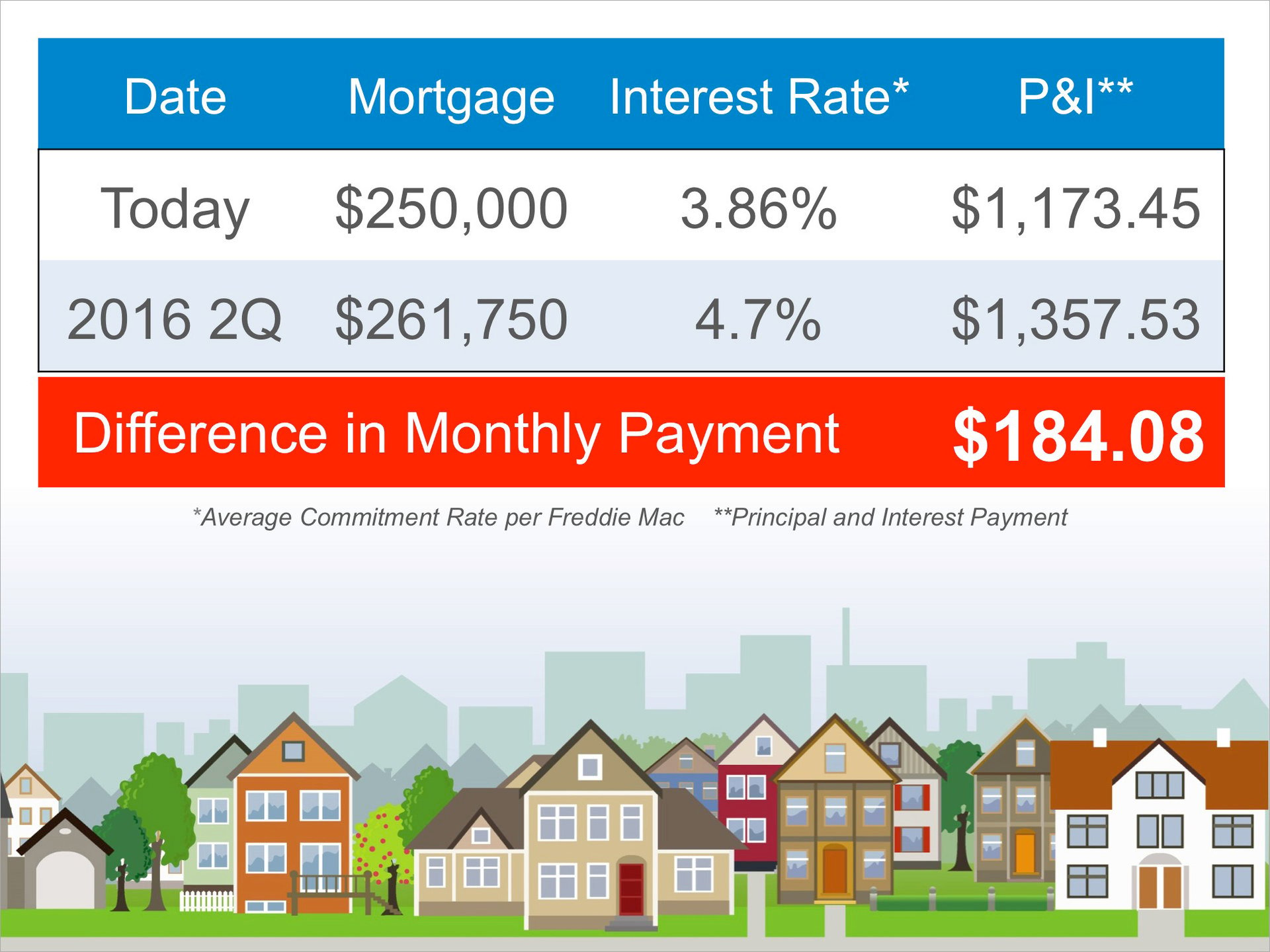
According to CoreLogic’s latest Home Price Index, prices are expected to rise by 4.7% by this time next year. Additionally, Freddie Mac’s most recent Economic Commentary & Projections Table predicts that the 30-year fixed mortgage rate will appreciate to 4.7% in that same time.

What Does This Mean to a Buyer?

Here is a simple demonstration of what impact these projected changes would have on the mortgage payment of a home selling for approximately $250,000 today:Cost of Waiting | Keeping Current Matters

Wednesday, September 16, 2015

Is Your Agent Asking 3 Critical Questions

In order to help focus a buyer on what is important to them in the home buying process, and help them decide if "NOW" is the right time to 'jump' if they see the home of their dreams, a real estate agent might want to ask the following questions.   These questions can help pin point potential issues that  are better resolved early in the Agent/Client relationship and result in a more satisfying and successful real estate transaction sooner rather than later.    
                                     Image result for photo of sales transaction          Image result for photo of sales transaction

To begin with, has your Agent started with this question:   "At what price would you see value in this property and be comfortable making an offer?" Rather than wait for a buyer to approach the Agent and suggest an offer, listing agents should remove the price barrier to further negotiations, increase the chances of multiple offers, and better gauge the home's market value. 

Secondly, has your Agent also asked you, the buyer, to discuss on a tour the home's positive and negative aspects to determine whether there are any minor cosmetic issues that could easily be remedied to eliminate any perceived negative impact on value.

Finally, has your Agent asked you, "If you come across your dream home today, are you in a position to take the first steps and secure it?" This inquiry helps the agent gauge whether you, the prospect,  have been pre-approved for a loan, whether you have a home that the agent's firm could potentially sell, and whether the agent should refer you to the firm's mortgage broker.

Knowing if an agent is the right one for any buyer or seller is a subjective evaluation.  However, certain standards of practice are always followed by agents who are top in their field and understand what steps to take in what order to ensure a successful and stress free transaction.  


[Adapted from:   "3 Critical Questions You Must Ask Every Potential Buyer"
REBusinessOnline.com (08/06/15) ; Dounis, Billy]

Do you know the difference between a Fixture and Personal Property in a Home Sale?

What’s a Fixture vs Personal Property


By:  Home (RE Exposure) » About Bill Gassett » Remax Executive Realty  


What Stays and Goes in a Home Sale

Inclusions vs Exclusions in a Home Sale47Occasionally in a home sale there are situations that can be very frustrating for a buyer or a seller, situations that should be avoidable. One potentially frustrating occurrence often arises in relation to “fixtures” in a home – items that are considered part of the house and therefore part of the sale. When a seller removes something that the buyer expected to get with the house, it can create significant tension and lead to resentment, and maybe even legal proceedings.
Any good Realtor should be well aware of the problems that can arise over the definition of fixtures in a home, and should prepare appropriately in the sales process. By getting clear from the start on what fixtures are versus personal property, the Realtor can help everyone enjoy a smoother transaction.
Many consumers have no idea what is considered a fixture and what is considered personal property. In fact many real estate agents are to blame for blurring the lines between these two things by “excluding” things in a listing agreement that don’t need to be excluded!
For example unless a washer and dryer is “built in” it does not need to be excluded as it is considered “personal property” and not part of the home. Refrigerators are also considered personal property unless they are built-in to the cabinetry like a “Sub-Zero”. This creates confusion on the part of the consumer when fixtures and personal property are treated in the same fashion.
Keep reading and you will see a comprehensive discussion on what is considered personal property and what is considered “real estate” or part of the property when selling a home.

What’s A Fixture?

A fixture is legally considered something like decorations, equipment or appliances that have been attached to the house. Fixtures are considered part of the property and it is a given that they will go to the buyer along with the rest of the property.
For instance, if you were to buy a house from a seller and discovered that he had removed all the door knobs when he moved out, you’d understandably be angry. The doorknobs are part of the house, and are definitely something you expected to get when you spent hundreds of thousands of dollars on it. Fortunately, sellers rarely run off with doorknobs. They are obviously fixtures, and obviously are included in the sale. But there are other things that you as a buyer may consider fixtures that the seller does not.
There are a few ways to look at fixtures in a home to determine their status, including:
Attachments
When something is screwed, nailed or glued to the walls, ceiling or floors, it can generally be considered an attachment. Even if you can technically remove the item, it may still be considered an attachment – things like custom cabinets, built-in speakers, etc.
Integral
The item may also be something that is generally considered an integral part of a home, like a refrigerator (if built in), cooking range, or a porch swing.
Guidance from the Greater Boston Real Estate Board
The Greater Boston Real Estate Board standard purchase and sale agreement has language that discusses what is and is not a fixture. The language is very helpful because it outlines in detail for both the buyer and seller what is and is not part of the property. There is a clear definition of what conveys and what does not.
“Included in the sale as part of said premises are the buildings, structures, and improvements now thereon, and the fixtures belonging to the SELLER and used in connection therewith, including, if any, all wall-to-wall carpeting, drapery rods, automatic garage doors openers, Venetian blinds, window shades, screens, screen doors, storm windows and doors, awnings, shutters, furnaces, heaters, heating equipment, stoves, ranges, oil and gas burners and fixtures appurtenant thereto, hot water heaters, plumbing and bathroom fixtures, garbage disposals, electric and other lighting fixtures, mantels, outside television antennas, fences, gates, trees, shrubs, plants, and ONLY IF BUILT IN, refrigerators, air conditioning equipment, ventilators, dishwashers, washing machines and dryer; and but excluding _______.”

How Personal Property And Fixtures Can Become Confused

It is not hard to imagine how the line between fixture and personal property could become muddled. If a home had an alcove above the stove that contained a high-end microwave, the buyer may imagine that the appliance comes with the house, especially if the microwave looked to be a part of the style of all the appliances in the kitchen. But the seller might have just bought the microwave to replace an old one. It’s not physically attached to the house, just sitting in its alcove. All he has to do is unplug it and take it when he leaves.
A few years ago while selling a home in Southborough Mass, a seller decided to take the control box for an underground dog fence. Needless to say it was not excluded and the buyer was very unhappy about it. These are the kind of things that can add quite a bit of stress to a real estate transaction.

Items That Cause The Most Issues

Fixture vs Personal Property47You would expect that the items that cause the most issues in a real estate transaction are the ones that have some grey area. These are the kind of items that could be considered real property or personal property. Some examples are:
  • Window treatments – this is one of my biggest pet peeves because it seems so many real estate agents do not grasp the concept. Curtains and drapes are considered personal property and do not stay with a home. Rods and blinds, however are attached and therefore stay with the home.
  • A swing set – This can go either way because some swing sets are just sitting in the grass. This would be considered personal property as it is not attached to anything. A swing set however that is cemented into the ground would be considered a fixture or part of the property.
  • A basketball hoop – the same can be said for a basketball hope. It goes without saying that if the hoop is cemented into the driveway it will stay with the home unless excluded from the sale. A free standing hoop however, would be considered personal property.
  • A mirror – this should be simple but often times it is not. If the mirror is bolted to the wall it stays. If it is hanging on a hook it does not stay with the home.
  • A wall mounted television – this is another one that really can be grey to a lot of people. Wall mounted televisions should be excluded if an owner desires to take them. Keep in mind anything bolted, screwed in or attached to a wall is considered part of the house! A sub issue that often times surfaces with wall mounted televisions is how the holes in the wall that are left behind will be addressed. Do not assume anything here when buying a home. If you want the holes patched this is something that should be addressed up front and agreed to in writing by the parties.
  • Lights – this one is one my list not because it is hard to distinguish that they are part of a home but because a lot of home owners forget to exclude lights they want to take with them. Some sneaky owners will take a light and put another in it’s place thinking the buyer will not remember. This is not a good way to conduct yourself in a real estate transaction but it happens.
  • Dog fence – this is an interesting one only because some sellers think it is perfectly acceptable to take the unit that powers the underground wiring. This is something that should become an exclusion.

Clarifying What Is What

When a Realtor goes to list a home, he or she should be extremely thorough in defining what is included in the home sale. When the listing is put up, it should contain all the fixtures that are excluded from the sale. I will repeat again when excluding items from a sale, personal property should not be included as it creates further confusion.
The same attention to detail must be applied when the Offer to Purchase is drafted. When the multiple listing service is thorough and exact in its descriptions of what comes with the house, it can then be referred to later in the Offer to Purchase. The same information on what is included in the sale and what is excluded in the sale must be made clear in the offer.

Make Sure You And Your Realtor Are On The Same Page


47
If you are going to sell your house, you want to make sure that you and your Realtor are always on the same page. A good real estate agent should be checking in with you, especially at the beginning of the sale, to make sure you understand what is going on and that your wishes are being honored in the sales process.
What is included and excluded should be discussed before the home is ever listed and it makes its way to the public.
When you talk to your Realtor about the listing, bring up the idea of clarifying what you consider personal property and what you consider fixtures, so that the Realtor can include all this information in the listing. After the listing is up, the real estate agent can also keep in mind any areas where confusion might arise and address them during the sales process with the buyers agent.
The last thing you want to be involved in is a situation where the buyer wants to back out of the home sale. This is stress that can be easily avoided!

Other Important Clarifications

One of the other bones of contention that often comes up in a home sale are extraneous things that the seller decides they should leave behind for the buyer to have. Sometimes the buyer loves the fact that these things are left behind and other times they want them gone. What kind of items am I talking about?
  • Paint – some buyers want all the paint left behind to do touch ups while others have no use for it and want it removed.
  • Extra tile – again sometimes people want extra tiles to stay and other times they plan on removing what is there.
  • Gardening items, pesticides, etc – some buyers love to have these things, while others don’t.
  • Wood – Some sellers see leaving wood for burning in the fireplace or wood stove as a major plus.
  • Miscellaneous items – anything that can be used around the house like garden houses, garbage cans, household cleaners, etc.
The point here is you should never take anything for granted when it comes to leaving items behind. A buyer should always be asked if they want anything left behind that is considered personal property.

Do a Final Walk Through

When you are buying a home it is always advisable to do a final walk through. One of the major purposes of doing so is to make sure that everything in the home is the same as when you signed your contact with the seller. While most buyers are looking for issues like a mover dinging a wall or other potential structural or mechanical issues, looking over what was supposed to be included is important as well.
Over my twenty eight years of selling real estate there have been a handful of occasions where something was taken that shouldn’t have been. In fact one time the seller had already left the state with all of their belongings on a truck and decided they wanted two lights that were not excluded.
The buyer of course wanted them and would not settle for what the seller put in their place. It took some wrangling of course with the attorneys but a holdback agreement was made where by the seller would not get a couple thousand dollars of their proceeds until the lights were returned to the buyers. This is just another reason that a final walk through should never be skipped!